
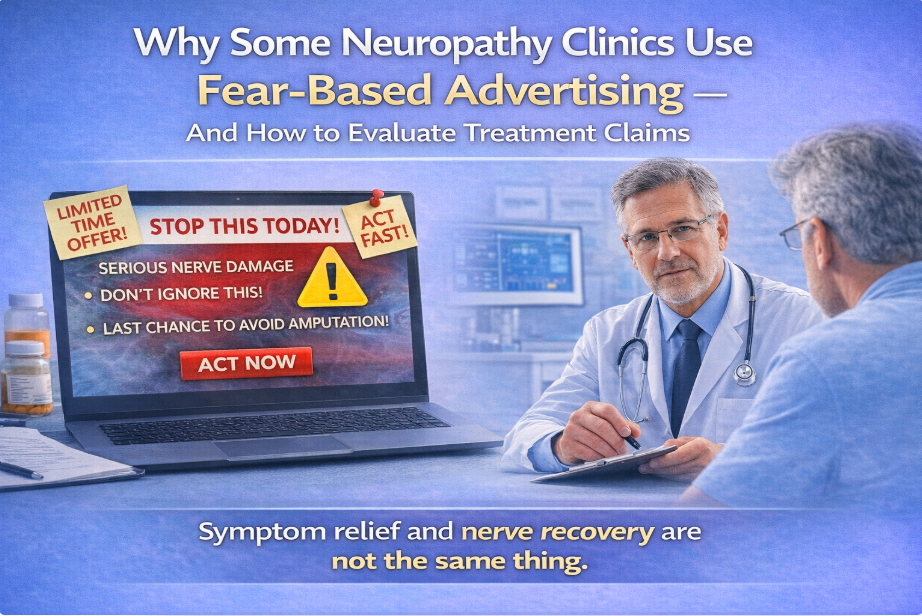

If you’ve searched online for neuropathy treatment, you’ve probably seen headlines like:
“Your Feet Could Be Amputated!”
“Neuropathy Leads to Limb Loss!”
“Act Now Before It’s Too Late!”
It can be alarming.
And understandably so.
Neuropathy is serious.
But it’s important to separate medical reality from marketing psychology.
First: Neuropathy Is Not Trivial
Peripheral neuropathy can affect:
- Sensation
- Balance
- Reflexes
- Skin protection
- Gait stability
In advanced cases – especially when combined with severe diabetes and vascular disease – complications such as ulcers and, rarely, amputation can occur.
Those risks are real.
They deserve respect.
But context matters.
Most patients with neuropathy are not on the immediate brink of amputation.
Why Fear Is Used in Advertising
Fear-based marketing works.
It increases:
- Attention
- Urgency
- Emotional response
- Immediate decision-making
In healthcare marketing, fear messaging often centers around worst-case scenarios to create urgency.
The problem is not that complications exist.
The problem is when rare outcomes are presented as inevitable outcomes.
The Difference Between Risk and Certainty
Severe complications typically occur when multiple factors are present, such as:
- Long-standing uncontrolled diabetes
- Significant vascular disease
- Loss of protective sensation
- Repeated untreated foot wounds
Neuropathy alone does not automatically lead to amputation.
Risk increases when neuropathy is ignored for years without protective care.
Context is important.
What Fear Advertising Often Leaves Out
Many fear-based messages focus exclusively on worst-case complications.
They may not explain:
- Staging differences
- Variability between patients
- The role of metabolic control
- The role of strength and balance
- The difference between pain and function
They often frame neuropathy as:
“Act immediately or face catastrophe.”
That may increase response rates.
But it can also increase unnecessary anxiety.
A Balanced Perspective
Neuropathy deserves early attention.
Untreated neuropathy commonly progresses over time.
For more on progression, see:
Is Neuropathy a Progressive Disease?
Early intervention can:
- Improve measurable nerve performance
- Reduce balance risk
- Improve strength
- Alter trajectory
For more on early treatment, see:
What Happens If Neuropathy Is Treated Early?
The goal of early care is efficiency – not panic.
Pain vs. Function
Fear advertising often focuses on:
- Burning pain
- Ulcers
- Amputation
But in over 20 years of focused neuropathy practice, many patients are primarily concerned about:
- Instability
- Weakness
- Loss of confidence walking
Neuropathy is not just about pain.
It is about nerve performance.
Effective care should address:
- Comfort
- Sensory detection
- Balance
- Strength
- Measurable improvement
For more on how neuropathy is measured, see:
How Is Neuropathy Measured?
How to Evaluate Any Neuropathy Clinic
When considering treatment, ask:
- How do you measure neuropathy?
- How do you track improvement?
- Do you differentiate pain from nerve function?
- What stage am I in?
- What are realistic expectations?
Any clinic – including ours – should be able to answer those questions clearly.
The Most Important Takeaway
Neuropathy is serious.
But it is not automatically catastrophic.
Fear-based advertising highlights worst-case scenarios to create urgency.
Balanced care focuses on:
- Measurable evaluation
- Stage clarity
- Realistic expectations
- Functional recovery
- Consistent reinforcement
Early action should be based on clarity – not fear.
Frequently Asked Questions
Q: Is amputation common with neuropathy?
A: Severe complications are typically associated with multiple uncontrolled risk factors, not neuropathy alone.
Q: Should I be scared if I have neuropathy?
A: Neuropathy deserves attention, but panic is not productive.
Q: Why do some ads feel alarming?
A: Fear messaging increases urgency and response rates in marketing.
Q: How should I choose a neuropathy provider?
A: Look for structured evaluation, objective measurement, and realistic expectations.
Next Step
If neuropathy symptoms are affecting sensation, balance, or comfort – whether painful or not – structured evaluation can clarify your stage and improvement potential without relying on fear-based messaging.
To learn more or request a consultation at Realief Neuropathy Centers of Minnesota, call 952-456-6160 or submit a request through our website.
Neuropathy deserves attention.
It does not require panic.
About the Author
Dr. Timothy Kelm is the founder of Realief Neuropathy Centers of Minnesota and has spent over 20 years focused exclusively on the evaluation and treatment of peripheral neuropathy. He has worked with thousands of neuropathy patients and delivered tens of thousands of neuropathy-focused treatments.
He is associated with published clinical research conducted in collaboration with the University of Minnesota and holds a nationally issued patent related to neuropathy treatment methodology. He has delivered public educational presentations and trained physicians nationally on structured neuropathy care.
Over 20 years ago, his interest in neuropathy began after repeatedly seeing patients who were told there were no good options. He believed then – and continues to believe today – that neuropathy should not define your life.