

When people think about neuropathy, they usually think about pain.
Burning. Tingling. Numbness.
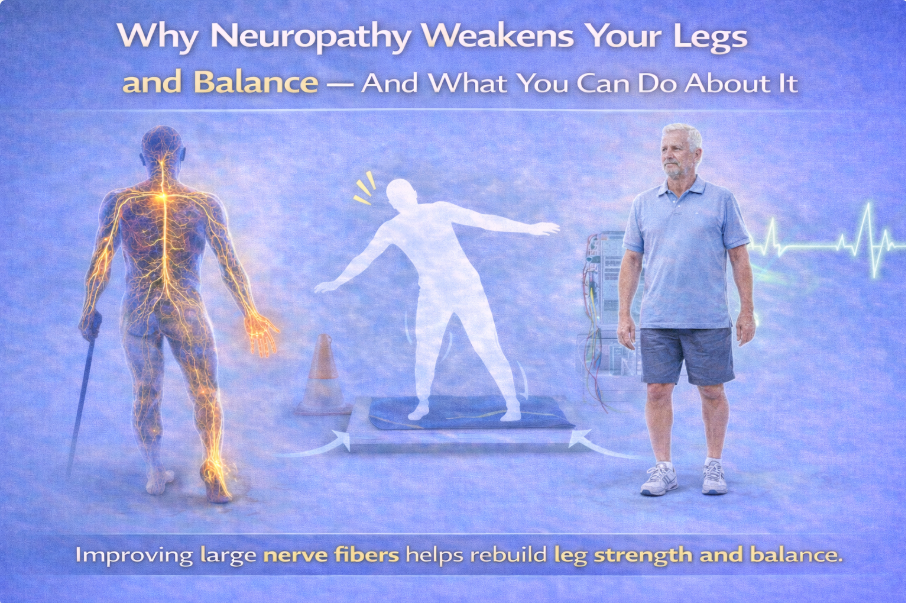
But one of the most important – and most dangerous – effects of neuropathy is loss of balance.
Falls are not random in neuropathy.
They are predictable.
And they are preventable when recognized early.
Why Balance Depends on Nerves
Balance requires three systems working together:
- Vision
- Inner ear (vestibular system)
- Sensory feedback from the feet and legs
Peripheral nerves in the feet provide constant feedback to the brain about:
- Pressure
- Surface changes
- Joint position
- Muscle tension
This feedback is called proprioception.
When sensory nerves are impaired, that feedback becomes unreliable.¹
The brain receives incomplete information.
Stability suffers.
How Neuropathy Leads to Weakness
Neuropathy does not only affect sensation.
Motor nerve fibers can also be involved.
When motor fibers are impaired:
- Muscle activation becomes less efficient
- Reaction time slows
- Strength declines gradually
Even subtle motor involvement increases fall risk.²
In many cases, patients do not initially perceive themselves as weak – they simply feel “less steady.”
The Hidden Progression of Instability
Instability often develops quietly.
Patients may notice:
- Holding onto railings more frequently
- Avoiding uneven surfaces
- Difficulty walking in the dark
- Feeling unsure when turning quickly
Loss of sensation reduces the body”‘s ability to correct small shifts in weight.
Over time, compensation patterns develop.
Tightness in the calves or arches may increase as muscles guard to create artificial stability.
But compensation is not correction.
Neuropathy and Fall Risk
Studies show that individuals with peripheral neuropathy have significantly increased fall risk.³
The reasons include:
- Reduced protective sensation
- Delayed motor response
- Impaired proprioception
- Orthostatic instability in autonomic involvement
Falls are not simply “clumsiness.”
They are neurological.
Early recognition changes prevention strategies.
Why Strength Training Alone Is Not Enough
Patients are often told to “strengthen the legs.”
Strength is important.
But if sensory input is impaired, the brain still lacks accurate positioning information.
Balance improvement requires:
- Sensory awareness
- Stability training
- Proprioceptive reinforcement
- Gradual functional challenge
Simply increasing muscle size does not restore nerve signaling.
Structured evaluation helps determine where deficits truly exist.
The Role of Tightness in Balance Problems
Persistent calf or arch tightness is common in neuropathy.
This tightness may reflect:
- Protective guarding
- Altered vascular tone
- Autonomic dysregulation
- Sensory instability
When sensation declines, muscles often contract subtly to create a sense of stability.
Over time, this increases stiffness without improving true balance.
Understanding the neurological driver prevents misclassification as purely orthopedic.
What Patients Can Do
If you are noticing instability:
- Avoid walking barefoot on uneven surfaces
- Use adequate lighting at night
- Be cautious on stairs
- Monitor changes in gait
But most importantly, seek structured evaluation.
Instability rarely reverses through awareness alone.
The Most Important Takeaway
Neuropathy affects more than pain.
It affects safety.
Loss of sensation and subtle motor impairment increase fall risk gradually.
Recognizing balance changes early allows for better monitoring and structured management.
Clarity improves prevention.
Frequently Asked Questions
Q: Can neuropathy cause leg weakness?
A: Yes. Motor nerve involvement can reduce muscle activation and coordination.
Q: Why do I feel off balance even if I”‘m not in pain?
A: Balance relies on sensory feedback. Reduced sensation can impair stability even without pain.
Q: Does neuropathy increase fall risk?
A: Yes. Peripheral neuropathy is strongly associated with increased fall risk due to sensory and motor impairment.³
Q: Can balance improve with neuropathy?
A: Improvement depends on underlying contributors and structured management. Monitoring and targeted intervention matter.
Next Step
If you are noticing instability, reduced confidence when walking, calf tightness, or increased fall risk, a structured neuropathy evaluation can help clarify what is contributing and how balance may be changing.
To learn more or request a consultation at Realief Neuropathy Centers of Minnesota, call 952-456-6160 or submit a request through our website.
Early clarity can influence long-term safety and trajectory.
About the Author
Dr. Timothy Kelm is the founder of Realief Neuropathy Centers of Minnesota and has spent over 20 years focused exclusively on the evaluation and treatment of peripheral neuropathy. He has worked with thousands of neuropathy patients and delivered tens of thousands of neuropathy-focused treatments.
He is associated with published clinical research conducted in collaboration with the University of Minnesota and holds a nationally issued patent related to neuropathy treatment methodology. He has delivered public educational presentations and trained physicians nationally on structured neuropathy care.
Over 20 years ago, his interest in neuropathy began after repeatedly seeing patients who were told there were no good options. He believed then – and continues to believe today – that neuropathy should not define your life.
References
- Richardson JK. The clinical implications of peripheral neuropathy and balance dysfunction. Mayo Clinic Proceedings.
- England JD et al. Distal symmetric polyneuropathy. Neurology.
- Menz HB et al. Peripheral neuropathy and falls in older adults. J Gerontol.