
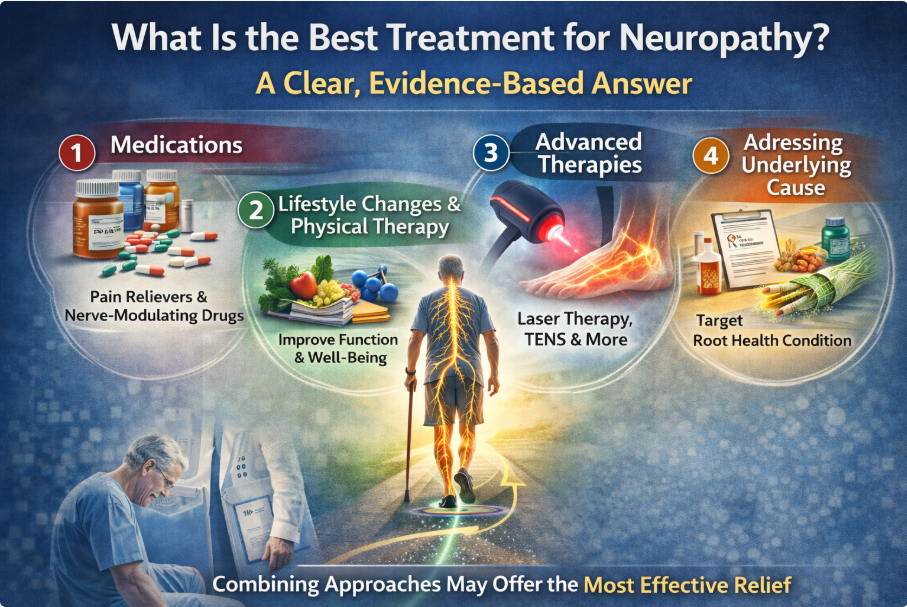

Many patients ask:
“What is the best treatment for neuropathy?”
They are often hoping for one simple answer.
One pill.
One device.
One breakthrough solution.
The honest answer is:
There is no single “best” treatment for every case.
The best treatment depends on the stage, cause, and severity of the neuropathy – and whether the goal is pain Realief or functional improvement.
Those are not the same thing.
First: Define the Goal
Neuropathy treatment generally falls into two broad categories:
- Symptom suppression
- Nerve function improvement
Most conventional treatment focuses on symptom suppression.
That may include:
- Gabapentin
- Pregabalin
- Duloxetine
- Topical creams
These medications may reduce burning or tingling.
They do not typically restore measurable nerve function.
Reducing discomfort and improving nerve performance are different goals.
Many People With Neuropathy Do Not Have Severe Pain
One important reality often overlooked in advertising:
Not all neuropathy is painful.
In over 20 years of focused neuropathy practice, a significant number of patients seeking care report:
- Minimal pain
- Intermittent discomfort
- Or no pain at all
Instead, their primary concerns are:
- Loss of balance
- Weakness
- Instability in low light
- Reduced walking endurance
- Tightness and stiffness
- Fear of falling
Pain is only one dimension of neuropathy.
Loss of nerve function is often the larger issue.
Most medications and many advertised “treatments” are designed to reduce pain signals – not restore nerve performance.
If someone”‘s main complaint is balance instability or weakness, pain suppression alone does not address the core problem.
Step One: Address the Underlying Cause
Before any treatment plan is built, contributing factors should be evaluated, including:
- Diabetes or prediabetes
- Vitamin deficiencies
- Thyroid dysfunction
- Autoimmune contributors
- Medication toxicity
- Circulatory issues
Correcting underlying contributors may slow progression.
For more on progression, see: Is Neuropathy a Progressive Disease?
However, correcting the cause alone does not always restore lost sensation or stability.
That requires additional strategy.
What About Laser Therapy?
Photobiomodulation (Class IV laser therapy) has been studied for its potential to:
- Improve circulation
- Enhance mitochondrial function
- Support nerve signaling
- Reduce inflammatory stress
Clinical studies suggest potential benefit in improving nerve conduction and sensory detection in certain populations.¹
Laser therapy is not a miracle cure.
But when applied in a structured protocol, it may support measurable nerve function improvement – not just pain reduction.
(We will expand this into a dedicated article.)
Does Exercise Help?
Yes – but it is supportive, not standalone.
Movement helps:
- Circulation
- Muscle activation
- Balance pathways
- Metabolic efficiency
For guidance on walking, see: Should You Walk With Neuropathy?
Exercise alone does not regenerate damaged nerves.
But it strengthens the system while nerve-focused intervention addresses function.
When balance and deconditioning are more advanced, patients may need to:
- Gradually increase walking tolerance
- Reinforce balance systems
- Rebuild lower extremity strength
- Reintroduce functional movement progressively
Strength and balance can absolutely improve.
Consistency matters.
Can Nerve Damage Be Reversed?
Peripheral nerves have regenerative capacity.
However, complete anatomical reversal is not guaranteed in chronic cases.
Measurable improvement is often achievable.
For more detail, see: Can Nerve Damage Be Reversed?
The best treatment strategy focuses on improving nerve performance – not simply reducing pain.
Does Stage Matter?
Yes.
Earlier-stage neuropathy typically responds more predictably than advanced-stage neuropathy.
For staging clarity, see: What Stage of Neuropathy Am I In?
Earlier intervention often produces:
- Faster measurable gains
- Greater sensory recovery
- More stable balance outcomes
Advanced cases can improve – but may require more structured rehabilitation.
Timing influences efficiency.
So What Is the “Best” Treatment?
The best treatment is:
- Structured
- Stage-specific
- Measurable
- Focused on nerve performance
- Reinforced with balance and strength training
Not hype.
Not fear.
Not just medication.
The best treatment changes trajectory.
It improves function – not just comfort.
The Most Important Takeaway
There is no universal single best treatment for neuropathy.
Many interventions focus primarily on pain suppression.
But many patients with neuropathy are more concerned about balance, strength, and independence than pain.
Peripheral nerves retain capacity for improvement.
Untreated neuropathy commonly progresses.
Earlier intervention tends to produce more predictable and meaningful gains.
The goal is not miracle reversal.
The goal is measurable functional improvement.
Frequently Asked Questions
Is there one best neuropathy treatment?
No. The best approach depends on stage, cause, and functional goals.
Do medications fix nerve damage?
Medications often reduce pain but do not typically restore measurable nerve function.
What if I don”‘t have much pain?
Loss of balance and strength are common concerns and require a different treatment focus than pain suppression.
Can neuropathy improve?
Yes. Measurable improvements in sensation, balance, and endurance are achievable.
Next Step
If neuropathy symptoms are affecting sensation, balance, or walking endurance – whether painful or not – structured evaluation can clarify your stage and improvement potential.
To learn more or request a consultation at Realief Neuropathy Centers of Minnesota, call 952-456-6160 or submit a request through our website.
The best treatment is the one that fits your stage and improves your function.
About the Author
Dr. Timothy Kelm is the founder of Realief Neuropathy Centers of Minnesota and has spent over 20 years focused exclusively on the evaluation and treatment of peripheral neuropathy. He has worked with thousands of neuropathy patients and delivered tens of thousands of neuropathy-focused treatments.
He is associated with published clinical research conducted in collaboration with the University of Minnesota and holds a nationally issued patent related to neuropathy treatment methodology. He has delivered public educational presentations and trained physicians nationally on structured neuropathy care.
Over 20 years ago, his interest in neuropathy began after repeatedly seeing patients who were told there were no good options. He believed then – and continues to believe today – that neuropathy should not define your life.