
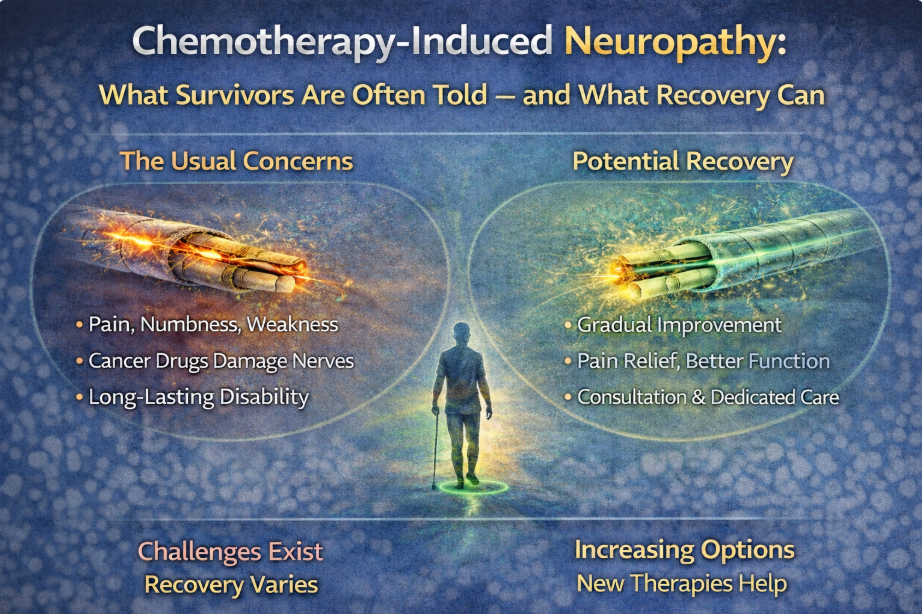

For many cancer survivors, completing chemotherapy is a major milestone.
But for some, nerve symptoms continue after treatment ends.
This condition is called:
Chemotherapy-Induced Peripheral Neuropathy (CIPN)
It may show up as:
- Numbness in the feet
- Tingling in the hands
- Burning sensations
- Hypersensitivity
- Instability when walking
- Difficulty with fine motor tasks
Pain may be present.
Sometimes it is significant.
Other times, numbness and coordination changes are more noticeable than pain.
Understanding the full picture matters.
How Common Is Chemotherapy-Induced Neuropathy?
Research shows that neuropathic symptoms are common during chemotherapy, and a portion of patients experience persistent symptoms afterward.
Large reviews suggest that chronic neuropathic pain persists in approximately 20–30% of patients on average, depending on the study and cancer type.¹
Rates may be higher with certain chemotherapy agents, particularly:
- Taxanes
- Platinum-based drugs
- Bortezomib
It is important to understand that many large studies focus primarily on pain as the main outcome measure.
Balance performance, vibration detection, and functional coordination are not always evaluated as primary endpoints.
That distinction matters.
How Chemotherapy-Induced Neuropathy Often Presents
CIPN can differ from other common neuropathies.
Many patients experience:
- Burning pain
- Electrical sensations
- Tingling in both feet and hands
- Early hand involvement
- Fine motor difficulty
Unlike typical diabetic or idiopathic neuropathy – which often begins gradually in the feet and progresses over time – chemotherapy-induced neuropathy may involve:
- Both hands and feet early
- More rapid onset
- More prominent pain during active treatment
Pain in CIPN is real and often significant.
However, not all patients continue to experience severe pain long term.
What often persists – and is less frequently measured in research – is:
- Numbness
- Reduced vibration detection
- Impaired proprioception
- Instability
- Coordination challenges
Pain may improve.
Functional deficits may remain.
What Many Survivors Are Told
Many patients are reassured:
“It should go away.”
For some, symptoms do gradually improve after chemotherapy ends.
For others, persistent numbness, instability, or coordination difficulty continues months or years later.
When research focuses mainly on chronic pain rates, survivors with lingering balance or sensory deficits may feel confused.
The absence of severe pain does not always mean full nerve recovery has occurred.
Why Chemotherapy Affects Nerves
Certain chemotherapy agents can:
- Disrupt axonal transport
- Interfere with mitochondrial energy production
- Affect small fiber integrity
- Impair nerve regeneration signaling
Peripheral nerves – especially the longest nerves to the feet – are particularly vulnerable.
This is why symptoms often begin distally and may involve both hands and feet.
Chemotherapy is lifesaving.
But survivorship may include nerve recovery challenges.
Pain vs. Functional Impact in CIPN
Pain matters.
Burning or electrical sensations can disrupt sleep and quality of life.
But in clinical practice, many cancer survivors seeking care report that their primary concern is:
- Instability
- Reduced walking confidence
- Difficulty with stairs
- Fine motor coordination issues
- Fear of falling
Pain-focused treatment alone may not address these functional concerns.
For more on balance recovery, see: Can Balance Be Restored in Neuropathy?
Does Chemotherapy-Induced Neuropathy Always Resolve?
Not always.
Some patients experience meaningful spontaneous improvement after treatment.
Others have persistent measurable sensory loss.
Recovery depends on:
- Total cumulative chemotherapy dose
- Type of agent
- Baseline nerve health
- Individual biological response
Peripheral nerves retain regenerative capacity.
But recovery is not always automatic.
For more on recovery potential, see: Can Nerve Damage Be Reversed?
Our Clinical Experience With CIPN
In over 20 years of focused neuropathy care, chemotherapy-induced neuropathy has been one of the most meaningful areas of focus in our clinic.
We have collaborated with the University of Minnesota on research specifically related to chemotherapy-induced neuropathy and structured treatment approaches.
Cancer treatment is lifesaving.
But survivorship deserves comprehensive nerve recovery support – not just reassurance.
The Most Important Takeaway
Chronic neuropathic pain after chemotherapy is not universal.
However, persistent numbness and balance impairment are common and often under-measured.
Pain is important.
Function is equally important.
Even when survivors are told symptoms “should go away,” measurable nerve dysfunction may persist.
Improvement may still be possible – even months or years after treatment.
Cancer survivorship is not just about remission.
It is about quality of life.
Frequently Asked Questions
Is chronic pain common after chemotherapy?
On average, approximately 20–30% of patients report chronic neuropathic pain, though rates vary by treatment type.
If I don’t have pain, does that mean my nerves recovered?
Not necessarily. Sensory loss and balance changes may persist without severe pain.
Can chemotherapy-induced neuropathy improve years later?
Yes. Peripheral nerves retain regenerative capacity, though improvement depends on multiple factors.
Is balance impairment common after chemo?
Yes. Many survivors report instability even when pain is minimal.
References
- Seretny M, et al. Incidence, prevalence, and predictors of chemotherapy-induced peripheral neuropathy: A systematic review and meta-analysis. Pain. 2014.
(Additional prevalence studies demonstrate higher rates with taxane and platinum-based agents.)
Next Step
If you are a cancer survivor experiencing numbness, instability, or reduced coordination after chemotherapy, structured evaluation can clarify your stage and improvement potential.
To learn more or request a consultation at Realief Neuropathy Centers of Minnesota, call 952-456-6160 or submit a request through our website.
Cancer treatment may be complete.
Recovery can continue.
About the Author
Dr. Timothy Kelm is the founder of Realief Neuropathy Centers of Minnesota and has spent over 20 years focused exclusively on the evaluation and treatment of peripheral neuropathy. He has worked with thousands of neuropathy patients and delivered tens of thousands of neuropathy-focused treatments.
He is associated with published clinical research conducted in collaboration with the University of Minnesota and holds a nationally issued patent related to neuropathy treatment methodology. He has delivered public educational presentations and trained physicians nationally on structured neuropathy care.
Over 20 years ago, his interest in neuropathy began after repeatedly seeing patients who were told there were no good options. He believed then – and continues to believe today – that neuropathy should not define your life.